Mix in key.
Two tracks in compatible keys blend without clashing. Euphoria finds the key of every track, shows which ones mix, and lets you see and hear why.
The Camelot wheel.
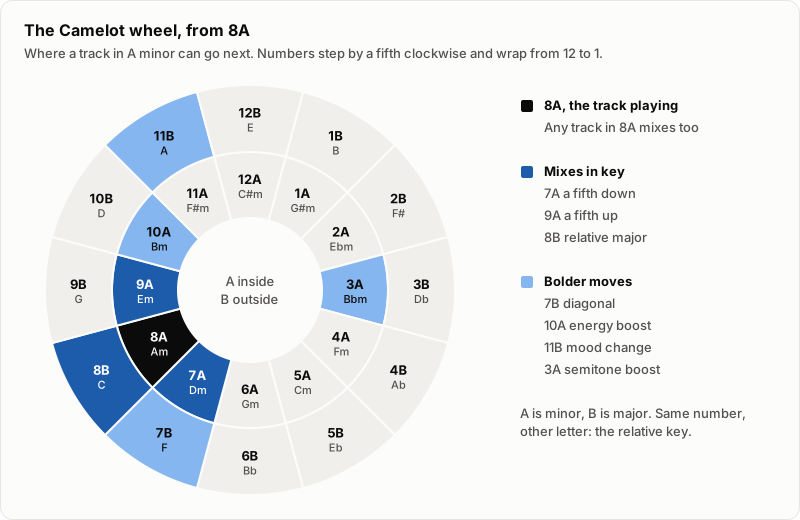
DJs write keys as Camelot codes: a number from 1 to 12 and a letter, A for minor and B for major. Neighbours on the wheel mix. Euphoria shows every key both ways, 8A and A minor.
One step around the wheel is a perfect fifth. Two notes a fifth apart, played into an oscilloscope, draw a 3 to 2 curve. That curve is the Euphoria logo.
Every move, as a curve.
Each move from 8A, drawn as the curve its two home notes trace. The names are the ones the app uses.
The same key. Always safe.
Mixes in keyA fifth apart. The classic harmonic mix.
Mixes in keyA fifth the other way: a fourth up.
Mixes in keyThe other letter, the same number: the same notes in major.
Mixes in keyOne step and the other letter. Six of seven notes are shared, so the mood shifts while the blend holds.
Bolder moveTwo numbers up. The key rises by a whole tone, a clear lift.
Bolder moveThe same home note in the other mode, A minor to A major. A dramatic change of mood.
Bolder moveSeven numbers up. The key rises by a semitone, a dramatic lift whose melodies clash.
Bolder moveKeys a tritone apart share little, so Euphoria never suggests this.
ClashesTry any two keys.
Two notes played into an oscilloscope draw a curve. Keys that mix draw simple ones. Pick a key for this track and the next, and watch.
Our own key model.
Euphoria detects keys with drone-v2, a neural network trained by the Euphoria project and built into the app. It runs on your computer in plain Rust, with no GPU and nothing to download.
15% more tracks with the exact key than KeyFinder, the free key detector that Mixxx also builds in.
Measured on the 604 GiantSteps Key previews of electronic dance music. GiantSteps guided drone-v2's development, so this is not a blind test. Every result, including the misses.
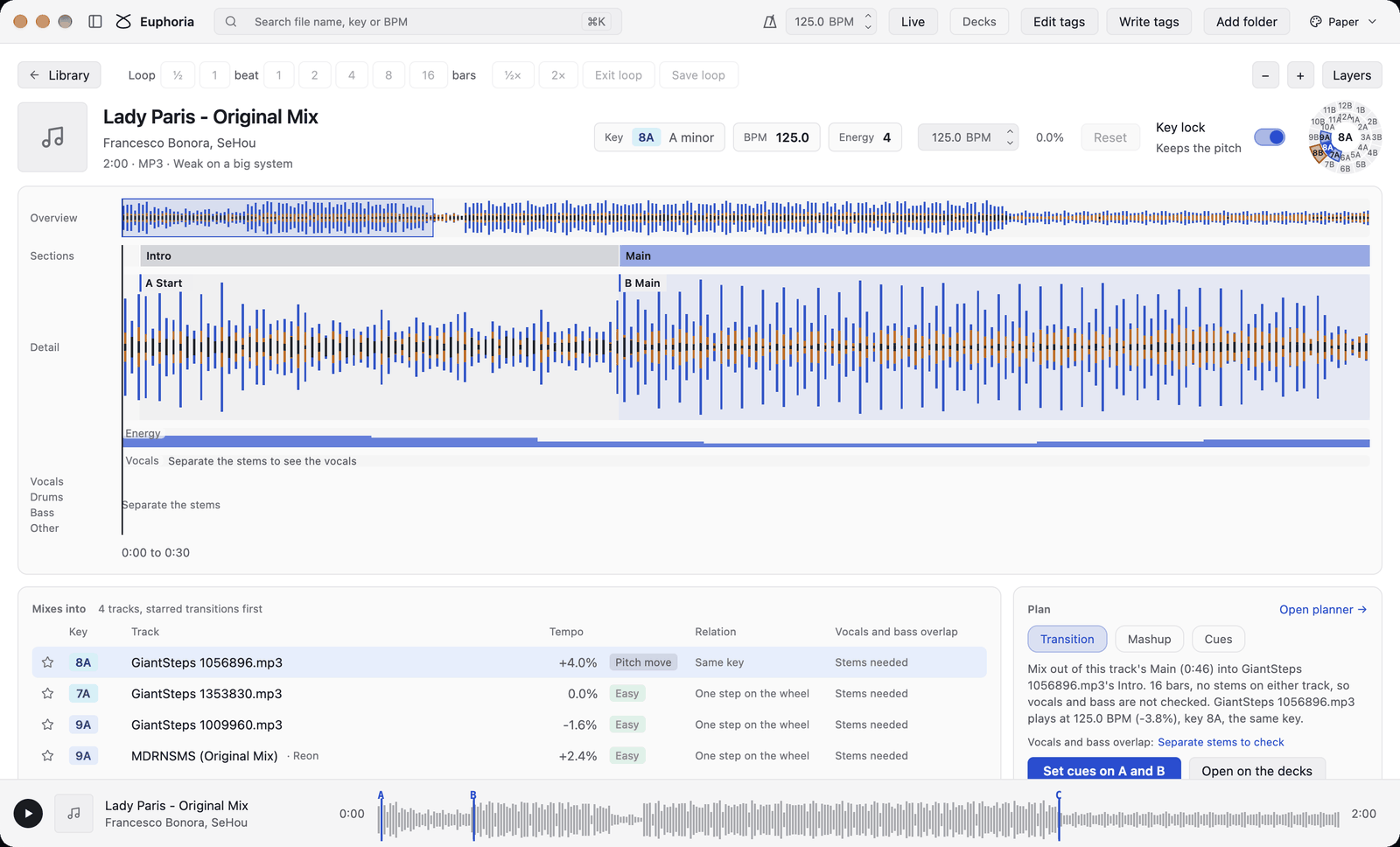
Mixing in key, in the app.
The same rules run everywhere you look for the next track.