Audio quality
Euphoria gives every track a quality verdict for DJ use, with a one sentence reason:
| Verdict | What it means |
|---|---|
| Lossless | A lossless file (FLAC, ALAC, WAV, AIFF) with a full spectrum. Nothing better exists. |
| Limited bandwidth | A lossless file whose content stops below 19 kHz with a gradual roll-off, as tape, vinyl and some lo-fi productions do. Information, not a defect: the file is lossless and nothing better exists. It is not a reason to look for another copy. |
| Good | Lossy audio at a high bit rate, such as 320 kbit/s MP3 or 256 kbit/s AAC, with the spectrum that bit rate keeps. Fine on any system. |
| Acceptable | Lossy audio at a medium bit rate, around 160 to 192 kbit/s. Fine in most rooms; a 320 kbit/s or lossless copy holds more detail. |
| Weak on a big system | Lossy audio at a low bit rate, such as 128 kbit/s. Fine for practice and small rooms; on a club system the top end and the detail suffer. |
| Likely re-encoded | The file’s bit rate promises more than its content holds: its sound stops where a lower quality file’s would, so it was most likely made from one. A 320 kbit/s file made from a 128 kbit/s one sounds like the 128 kbit/s one. A lossless file gets this verdict only when its spectrum ends in an encoder’s brick wall. |
The verdict is about the file, not the music. A great track in a weak file is still a great track: the verdict tells you which files are worth replacing with a better copy before you play them loud.
Find the files to replace
euphoria quality lists the files of a folder that are worth replacing, worst first, each with a short reason:
euphoria quality ~/Music/DJThe first line counts them, such as 32 of 576 tracks to replace: 2 heavily damaged, 9 fake lossless, 21 low bit rate. Heavily damaged files come first, then lossless files made from a lossy one (fake lossless) and other re-encoded files, then files weak on a big system, then lightly damaged files. Clipping is named in the reason of a listed file but does not list a file on its own, since a new copy of the same master is clipped too; --all shows it for every file. --min acceptable adds the medium bit rate files, and --m3u writes the list as a playlist to find the files in a DJ program. Tracks analyzed before are read from the cache. A Limited bandwidth file is never listed: nothing better exists. See euphoria quality for the options.
What is measured
| Measurement | What it is |
|---|---|
| Codec | The audio codec, such as MP3, AAC, Vorbis, FLAC, ALAC or PCM, and whether it is lossless. |
| Bit rate | The average bit rate of the audio data, measured from the size of every audio packet and the length of the audio. Tags and artwork are not counted. For a variable bit rate file this is the real average, which can be well below the setting it was encoded with. |
| Sample rate, bit depth, channels | As the file declares them. Bit depth only exists for lossless files. |
| Cutoff | The frequency where the content stops. See below. |
| Clipping | The share of samples that lie in runs of three or more at full scale, in any channel. |
| Loudness | Integrated loudness in LUFS, measured as EBU R128 describes, on the mono mixdown. |
| True peak | The highest peak between samples in any channel, in dB relative to full scale, estimated by interpolating four times between samples near the loudest ones. |
Everything is measured during the existing decode for key, tempo and energy, with its loudness measurement reused. The cutoff processes each channel separately. Benchmark results record the measured CPU cost.
The cutoff
Lossy encoders save space by removing the highest frequencies, above a cutoff that depends on the bit rate: around 16 kHz for 128 kbit/s MP3, around 20 kHz for 320 kbit/s. Above the cutoff the spectrum falls by 30 to 60 dB within a few hundred hertz. Music on its own never falls that steeply, even when it is dark: a muffled track loses its highs gradually.
Euphoria measures each channel separately and combines their spectral energy across the whole track. This keeps opposite-phase stereo content from cancelling as it would in a mono mixdown. It looks for the steepest fall above 8 kHz between two bands 1 kHz wide. A fall of at least 20 dB is the cutoff; anything less means the content runs to the top of the spectrum.
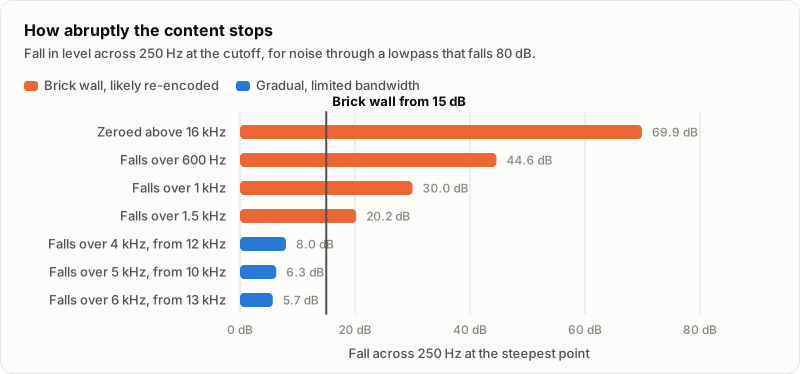
The cutoff also records how abrupt the fall is. Euphoria compares the average level of the 250 Hz below the cutoff with the 250 Hz above it, at the steepest point near the cutoff. A lossy encoder’s lowpass falls by 20 dB or more across that gap and leaves at least 30 dB between the 1 kHz bands; the roll-off of tape, vinyl or an analog filter falls by under 10 dB even when it drops 80 dB over a few kilohertz. A fall of 15 dB or more across 250 Hz, with at least 30 dB between the 1 kHz bands, is a brick wall. The line was set on generated signals, noise through a lowpass that falls 80 dB over different widths: widths up to 1.5 kHz measured 20 to 70 dB, widths of 4 to 6 kHz measured 6 to 8 dB. No real recordings were used to tune it.
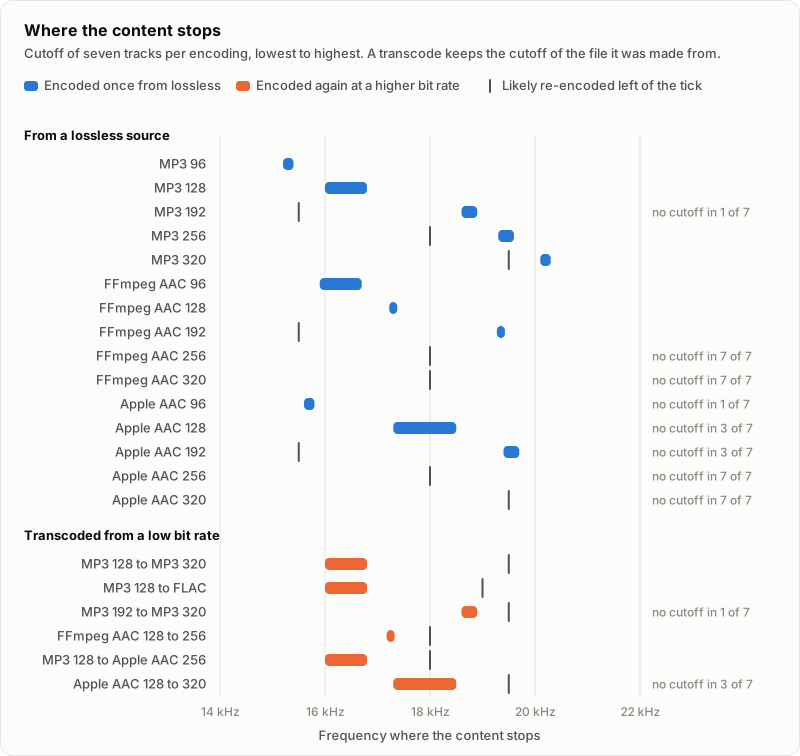
Re-encoding cannot bring back what was removed. A 128 kbit/s file turned into 320 kbit/s keeps its cutoff at 16 kHz, which is how it gives itself away.
Where the thresholds come from
The thresholds were set by measurement, not from received wisdom about bit rates. bench/quality_benchmark.py took six lossless tracks of electronic music published under Creative Commons (from the album Lithium Toolbox, Argali Records, CC BY-SA 3.0) and three synthesized ones (a wideband dance loop, a dark version of it through a gentle 3 kHz lowpass, and a heavily clipped version). It encoded each at 96, 128, 192, 256 and 320 kbit/s with LAME (MP3), FFmpeg’s AAC encoder and Apple’s AAC encoder, made transcodes from low bit rates up to high ones, and measured each file. The full table is in bench/results/quality.md. What it showed:
| Encoding | Average bit rate measured | Cutoff measured | Encoding error below 15 kHz |
|---|---|---|---|
| MP3 96 | 96 | 15.2 to 15.4 kHz | -24 dB |
| MP3 128 | 128 | 16.0 to 16.8 kHz | -26 dB |
| MP3 192 | 192 | 18.6 to 18.9 kHz, or none | -30 dB |
| MP3 256 | 256 | 19.3 to 19.6 kHz | -47 dB |
| MP3 320 | 320 | 20.1 to 20.3 kHz | -52 dB |
| Apple AAC 128 | 106 to 126 | 17.3 to 18.5 kHz, or none | -33 dB |
| Apple AAC 192 | 155 to 190 | 19.4 to 19.7 kHz, or none | -40 dB |
| Apple AAC 256 | 208 to 261 | none | -42 dB |
| Apple AAC 320 | 297 to 317 | none | -43 dB |
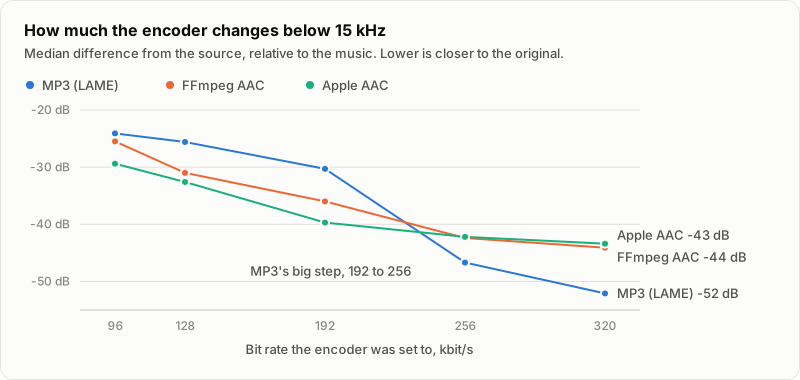
The encoding error is the difference between the decoded file and the original below 15 kHz, below every cutoff, relative to the music. It is a plain measure of how much the encoder changed, not a measure of what you hear, but it shows where the big step is: from 192 to 256 kbit/s for MP3, and from 128 to 192 kbit/s for AAC.
The thresholds that follow:
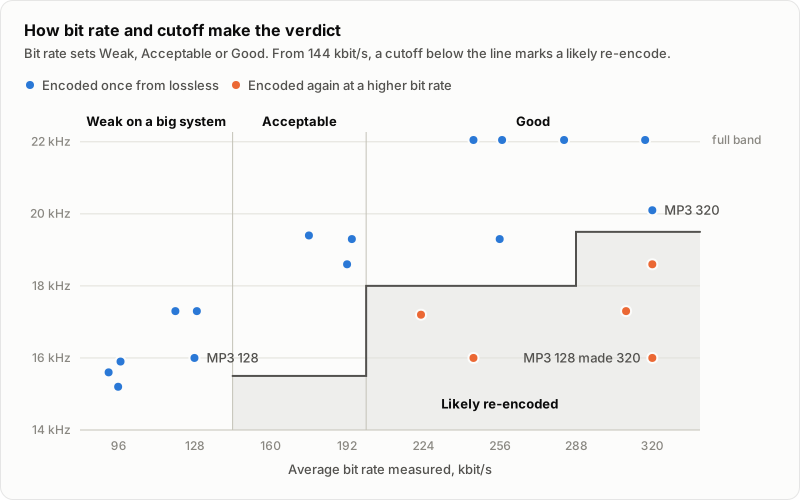
- Good from an average of 200 kbit/s. Apple’s encoder set to 256 kbit/s averaged 208 on the quietest track, so the line sits below the nominal rate.
- Acceptable from 144 kbit/s. Encoders set to 128 kbit/s measured at most 129, and set to 192 kbit/s at least 155.
- Weak on a big system below that.
- Likely re-encoded when the cutoff is below what the bit rate keeps: below 18 kHz at 200 to 287 kbit/s, below 19.5 kHz from 288 kbit/s, and below 15.5 kHz at 144 to 199 kbit/s. These lines sit under the lowest cutoff any encoder reached at that bit rate from a lossless source, and above the cutoffs of most transcodes. 38 of 42 music transcodes are caught. The 4 that are missed show no clear fall in their spectrum after re-encoding: three times because Apple’s encoder had kept the whole spectrum at 128 kbit/s, once because re-encoding added content above the earlier cutoff.
- Lossless files stopping below 19 kHz are called Limited bandwidth, or Likely re-encoded only when the fall is a brick wall as above. A cutoff has to be below 0.9 times half the sample rate to count, so a 22.05 kHz file is not judged by a cutoff it cannot reach.
- Mono files are judged by their bit rate per channel: a mono file counts double, so mono 96 kbit/s is judged as stereo 192. Every other line is unchanged.
- Low sample rates: the cutoff a lossy file is expected to reach is held to 0.9 times half the sample rate. MPEG-2 MP3 at 22.05 or 32 kHz, up to 160 kbit/s, could otherwise never reach 15.5 kHz at 144 to 160 kbit/s and read as re-encoded.
- Clipping never changes the verdict. When at least 0.1% of the samples are clipped, the reason adds that the master is clipped in places.
Ogg Vorbis
Vorbis is encoded at a quality level, not a bit rate, and averages far below the level’s nominal rate: quality 6, nominally 192 kbit/s, averaged 116 to 162 kbit/s on the same music, and quality 8, nominally 256, 148 to 221. Judged by the lines above, most quality 6 files, the level most people use, would be called weak. Vorbis files get lines of their own, from the same benchmark run with the reference encoder, oggenc:
| Verdict | Vorbis average bit rate |
|---|---|
| Good | From 145 kbit/s: quality 8 and above, and busy tracks at quality 6. |
| Acceptable | From 110 kbit/s: quality 6. |
| Weak on a big system | Below 110 kbit/s: quality 4 and below. |
| Likely re-encoded | A cutoff below 18.5 kHz from 145 kbit/s, or below 18 kHz from 110 kbit/s. The reference encoder stopped no lower than 18.9 kHz at quality 6. A Vorbis file made from a 128 kbit/s MP3 keeps the MP3’s cutoff and is caught. |
The reference encoder keeps more of the top end than LAME at each level, often all of it, so a Vorbis file made from another Vorbis file of low quality, and a lossless file made from one, are recognised only when the first encoding cut below the line. The benchmark results have the full table.
Damaged files
A file that is truncated or corrupt used to be analyzed as if it were fine. Euphoria now counts what went wrong while decoding and compares the length it decoded with the length the container declares. A file is damaged when the decoder dropped any packet, or the decoded audio is shorter than the declared length by more than 0.5% of it and at least a quarter of a second. Containers round their length, and encoder delay moves it by a few hundredths of a second, so smaller differences are not damage. A file that declares no length can only be damaged by dropped packets.
A packet the decoder rejects, or a stretch a reader had to skip to find the next valid packet, is replaced by silence of the same length. The times after it do not move, so a cue or beat grid time stays right, and the length of the track is still the length of the file. The quality report keeps the number of dropped packets, the seconds of silence, the length the file declares and the length decoded.
A file is heavily damaged when the audio lost, the silence put in place of dropped packets plus what is missing against the declared length, is 2% or more of the track, about 8 seconds of a 7 minute track. Below that a gap is shorter than a phrase and the beat grid still fits the rest. From 2% a gap can hide a whole phrase and the sections around it, so Euphoria does not write a beat grid or cues for the file, and says so in the notes. The key, tempo and energy are still reported, with the damage noted, since they come from the whole sound. The threshold is a judgement, not a measurement; it is a constant, SEVERE_LOST_SHARE.
Damage shows as a damaged flag with the details in damage and notes in the JSON, as a line in the detailed view of euphoria analyze, and as a note under the sound quality in the desktop inspector. It does not change the verdict: the verdict is about how the file was encoded.
Reading stops at a read error, such as the end of a file cut inside a packet. That counts as damage only when the audio decoded is short of the declared length: some formats end a normal file with the same error. Tests cover a truncated WAV and MP3, a FLAC with corrupt frames and a heavily damaged file with no cues; they use small generated files. A dropped packet in an MP3 is probably not found from timestamps, since the MP3 reader appears to number packets as it reads them, so an MP3 with one corrupt frame in the middle may show only when its decoded length falls short of its declared one. That case was not tested.
Channels that cancel
Euphoria mixes a stereo file down to one channel by averaging. Two channels that are inverted copies of each other average to silence, and a file like that, from a phase mistake in a recording or an export, used to be reported as silent. Now every block of about 0.4 seconds of stereo is checked: when its mono mixdown holds less than 5% of the energy of its two channels, the left channel is used for that block. For two channels of equal level, 5% means a correlation below -0.9, which real music does not reach. Wide stereo stays above 20%. A file with 5% or more of its length mixed this way gets a note, and cancelled_share in the JSON gives the share.
The cutoff and the other measurements that read every channel are not affected.
Limits
- It judges the file, not the master. A badly mastered track in a lossless file is still lossless.
- Medium bit rates hide their source. Between 144 and 199 kbit/s the line sits at 15.5 kHz, so only a source of 96 kbit/s or less is recognised. The three encoders measured all stopped at 18.6 kHz or higher at 192 kbit/s, but the line stays low because encoders not measured here may cut lower at these bit rates.
- Good sources leave no trace. A file made from a 320 kbit/s MP3 or from a 256 kbit/s AAC file keeps a high cutoff and passes as what it claims.
- Some files have their own lowpass. A master with a deliberate steep lowpass can stop early without having been encoded twice, and a lossless file made from such a master reads as likely re-encoded. A gradual roll-off, as in an old recording, a vinyl transfer or a lo-fi production, is called Limited bandwidth; the cutoff in the details shows where it stops. A lossy file that was never re-encoded but whose own source was dark can still read as re-encoded: for lossy files the verdict does not consider the shape.
- The brick wall line is not tuned on real recordings. It rests on generated signals. A real recording with a very abrupt analog or digital filter near 16 kHz, such as an old digital master with an anti-alias filter, would read as likely re-encoded.
- Lossy encoding hides clipping. A master clipped hard measured about 1% of its samples clipped as a lossless file, and between 0% and 0.2% after lossy encoding. A clipping figure of zero in a lossy file does not prove a clean master.
- Peaks above 0 dB are normal in lossy files. Decoding a loud master often gives true peaks of +1 or +2 dB. Most players and DJ software handle them; the figure is there for reference.
- The thresholds come from four encoders. Files from other encoders, such as Fraunhofer’s, aoTuV’s Vorbis encoder or those of streaming services, were not measured, nor Vorbis set to a bit rate rather than a quality level.
- The loudness is measured on the mono mixdown, as for the energy rating. It can differ from a stereo measurement by about a decibel.